 Lindsey Jeffers
Counselling
MenuClose
Reading list
Understanding parental narcissism
Here, I share three books which my clients have found the most useful. All are also available as audiobooks.
- Available as audiobooks
- Often free from your library
- No affiliate links
Why reading can help
A companion to therapy
While no book can replace the insight, safety and individualised support of therapy, the right book can be a valuable companion throughout the healing process.
Many clients find that reading between sessions helps them make sense of their experiences, provides language for feelings they have struggled to express, and reassures them that they are not alone in the lasting effects of growing up with a narcissistic parent.
The books below each offer a different perspective on understanding and recovering from narcissistic family dynamics. Whether you are only beginning to question your childhood, working through grief and self-worth, or learning to build healthier relationships, they can deepen reflection, support conversations in therapy, and reinforce the work we do together. Reading one or more of these books may even mean you need fewer counselling sessions.
Together, these three books offer complementary perspectives rather than competing ones. They can support a therapeutic journey from recognising narcissistic family dynamics, through grieving their impact, to building healthier relationships and a stronger sense of self.
Best for
The early stages of therapy, or considering therapy for the first time
Step 1 · Beginning to question
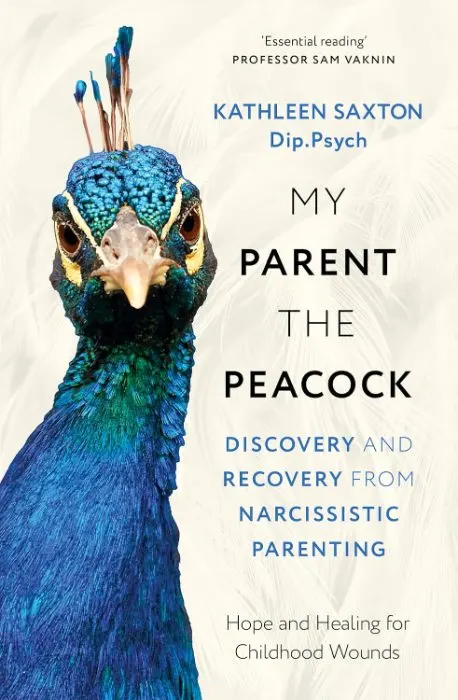
My Parent the Peacock
Discovery and recovery from narcissistic parenting
Kathleen Saxton (2025)
If you're only just beginning to wonder whether your childhood was shaped by a narcissistic parent, My Parent the Peacock is a good place to start. Kathleen Saxton, a BACP- and UKCP-registered psychotherapist, writes with warmth and clarity, helping readers put words to experiences that may have felt confusing for years.
Rather than becoming caught up in whether a parent would meet the diagnostic criteria for Narcissistic Personality Disorder, Saxton focuses on the impact of growing up with narcissistic behaviours. She explores patterns such as emotional invalidation, conditional love, guilt, enmeshment, family roles, and the lasting effects these can have on self-esteem, relationships and identity.
Her trauma-informed approach acknowledges narcissism as existing on a spectrum, making the book accessible to those whose parent may not fit every stereotype but whose childhood nonetheless felt emotionally unsafe or confusing.
For someone seeking to understand and heal, the book is reassuring rather than overwhelming. It helps adult children of narcissistic parents move away from self-blame and towards a more compassionate understanding of why they developed certain coping strategies. The reflective exercises are gentle and encourage curiosity rather than judgement, making the book feel like a supportive companion rather than a demanding workbook.
This book is particularly well suited to someone in the early stages of therapy, or even considering therapy for the first time. It provides a shared language for discussing family dynamics and can help clients begin to recognise patterns that may emerge more deeply in the therapeutic relationship.
For those working with a therapist trained in Karyl McBride's Five-Step Recovery Model, My Parent the Peacock offers a compassionate foundation from which the more structured work of grieving, boundary-setting and rebuilding a sense of self can naturally develop.
One of the book’s strengths is its grounding in research. Saxton summarises the evidence base, making it accessible and digestible, and the ‘Further Resources and Materials’ at the end of the book are useful and comprehensive.
Of the three books, this book feels the most contemporary and broadly inclusive in tone, even though diversity is not its central subject.
Best for
Those ready to explore how the past shapes their self-worth
Step 2 · Grieving and self-worth
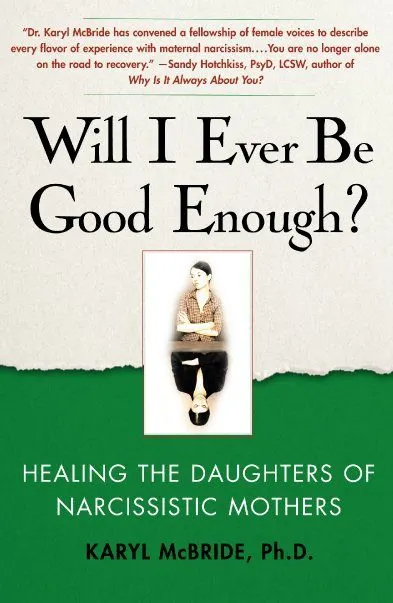
Will I Ever Be Good Enough?
Healing the daughters of narcissistic mothers
Karyl McBride (2008)
For many women raised by narcissistic mothers, Will I Ever Be Good Enough? is the book that finally makes them feel understood. Dr Karyl McBride, a family therapist with decades of clinical experience, explores the profound impact of growing up feeling that love had to be earned through achievement, perfection or self-sacrifice.
The book goes beyond describing narcissistic parenting and gently uncovers the beliefs many daughters carry into adulthood: "I'm not enough", "I mustn't make mistakes", or "Other people's needs matter more than mine." Reading it can be both painful and deeply validating, as McBride articulates emotional experiences that many readers have struggled to explain, even to themselves.
McBride shares the (anonymised) voices of many clients. These stories help people realise they’re not alone in their experience, and this validation can be an antidote to lifelong shame, providing a much-needed sense of community and belonging.
What makes this book especially valuable is its emphasis on healing. McBride introduces practical exercises that encourage grieving the mother you needed but did not have, challenging the internalised critical voice, developing healthier boundaries and beginning the process of re-parenting yourself.
These themes form the basis of McBride’s Five-Step Recovery Model, making the book particularly relevant for anyone working therapeutically within that framework.
This is not necessarily the first book I would recommend to someone who is only beginning to question their childhood, as its emotional depth can feel intense. However, for clients who have already recognised the narcissistic patterns in their family and are ready to explore how those experiences continue to shape their self-worth, it can become an invaluable companion throughout therapy.
Reading it alongside sessions often helps clients make connections between their past and present, giving language to experiences that can then be explored safely with their therapist.
It’s worth bearing in mind that this book shows its age. McBride focuses on traditional, nuclear families and the examples provided are less culturally expansive than the other two books on this reading list.
Best for
The middle and later stages of recovery
Step 3 · Building healthier relationships
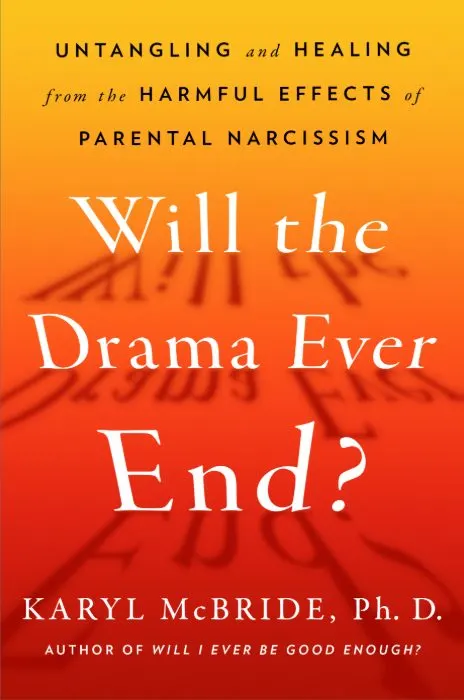
Will the Drama Ever End?
Untangling and healing from the harmful effects of parental narcissism
Karyl McBride (2023)
While Will I Ever Be Good Enough? focuses primarily on the daughters of narcissistic mothers, Will the Drama Ever End? widens the lens to adult children of narcissistic parents.
McBride explores how early experiences continue to influence adult relationships through familiar patterns being inadvertently repeated with partners, friends, colleagues and even their own children.
One of the book's greatest strengths is its ability to connect childhood survival strategies with present-day difficulties. People-pleasing, weak boundaries, over-responsibility, attraction to emotionally unavailable partners, or feeling responsible for managing everyone else's emotions begin to make sense when viewed through the context of early family dynamics. Rather than asking, "What's wrong with me?", the reader begins asking, "What did I learn that once helped me survive but no longer serves me?"
This book is particularly helpful for clients who have already begun processing their childhood and are now asking how to create healthier relationships going forward. McBride's recovery framework offers practical guidance on recognising unhealthy dynamics, grieving losses, strengthening boundaries and developing more authentic ways of relating to others.
For someone attending therapy with a practitioner trained in McBride's Five-Step Recovery Model, this book can serve as an excellent companion during the middle and later stages of recovery.
It reinforces many of the concepts explored in therapy and helps clients understand that healing is not only about making sense of the past but also about building different patterns for the future. By the final chapters, the emphasis shifts from surviving a narcissistic family system to creating a life that is no longer organised around it.
While this book remains culturally similar to McBride’s previous work, it’s likely that more readers will see themselves reflected here. It’s worth noting that many readers from diverse backgrounds find McBride's books profoundly validating because the emotional dynamics she describes transcend culture.
At the same time, those readers may benefit from exploring with their therapist how cultural values, family expectations and intersecting aspects of identity influence both their experience of narcissistic parenting and their path to recovery.
Good to know
Before you start reading
No expectation to read
Please note, if you’re considering therapy with me, I do not expect you to read any of these books. This curated list is intended to assist you in locating professionally written self-help materials which are grounded in research and can complement therapy if you so choose.
Where to find them
You may find these books/audiobooks available for free from your local library. If you’re thinking of purchasing, you could buy second-hand, or you may want to consider ordering from your local bookshop. There’s also UK Bookshop.org or Libro.fm, where every purchase financially supports local independent bookshops. I don't have any commercial affiliation with any of these booksellers. If you choose to make a purchase, I don't receive payment, commission or any other benefit.
Culture and identity
These books focus on family relationships rather than on the ways those relationships intersect with culture, race, class, disability or sexuality. In recent years, there has been growing recognition that these intersections matter. For example, expectations around obedience, emotional expression, caregiving or family honour can shape how narcissistic dynamics are experienced and how safe it feels to set boundaries. A therapist can help clients explore these nuances in ways that a general self-help book often cannot.
Karyl McBride's Five-Step Recovery Model
If your therapy follows Karyl McBride's Five-Step Recovery Model, these books complement different stages of that journey, helping to translate therapeutic insights into everyday understanding and lasting change.
What next?